Auto AC Basics; How Does Auto AC Work and can Performance be improved?
 Auto AC Basics; How does Auto AC Work, How do I Know if all is Well?
Summer is around the corner, is your auto AC working properly? The first thing to understand about auto AC basics, before attempting “easy fixes” from the retail giants, is how auto AC works, and how you might be able to fix or improve Auto AC performance.
Part 1: Understanding Auto AC Basics; Car Air Conditioning
It is important to realize that auto AC basics is based on a refrigerator in a different layout. It’s designed to 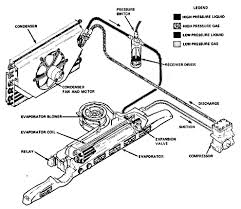 move heat from one place (the inside of your car) to some other place (the outdoors). While a complete discussion of every specific model and component is well outside the scope of this article, the following explanations of auto AC should give you a start on figuring out what the problem might be. This should also help you work with the right pieces if fixing it yourself or it will help you to talk intelligently to someone you can pay to fix it. Become familiar with the major components to auto air conditioning:
•Compressor:
This compresses is another basic part of auto AC basics and circulates the refrigerant in the system of the auto AC •Refrigerant: On modern cars, this is usually a substance called R-134a, while older cars have r-12 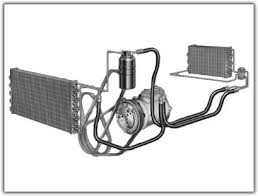 Freon in the auto AC, which is becoming increasingly more expensive and hard to find, Freon also requires a license to handle. The refrigerant carries the heat.
•Condenser:
The condenser is part of auto AC basics that changes the phase of the refrigerant from gas to liquid and expels heat removed from the car through the auto AC.
•Expansion valve (or orifice tube in some vehicles):
This part of auto AC basics is somewhat of a nozzle and functions to simultaneously drop the pressure of the refrigerant liquid, meter its flow, and atomize it within the auto AC. •Evaporator: This transfers heat to the refrigerant from the air blown across it, which is a vital part of the auto AC in cooling your car.
•Receiver/dryer: This functions as a filter for the refrigerant/oil, removing moisture and other 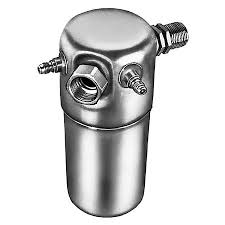 contaminants from the auto AC system. Understand the air conditioning process of you auto AC is much the same as any refrigerant process. In a nutshell, the compressor puts the refrigerant under pressure and sends it to the condensing coils. In your car, these coils are generally in front of the radiator. Compressing a gas makes it quite hot. In the condenser, this added heat and the heat the refrigerant picked up in the evaporator is expelled to the air flowing across it from outside the car. When the refrigerant in the auto AC system is cooled to its
 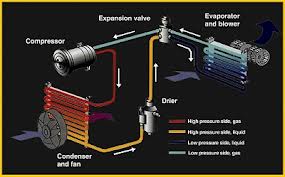 saturation temperature, it will change phase from a gas back into a liquid (this gives off a bundle of heat known as the “latent heat of vaporization”). The liquid then passes through the expansion valve in the auto AC system to the evaporator, the coils inside of your car, where it loses pressure that was added to it in the compressor. This causes some of the liquid to change to a low-pressure gas as it cools the remaining liquid. This two-phase mixture enters the evaporator, and the liquid portion of the refrigerant absorbs the heat from the air across the coil and evaporates. Your car’s blower circulates air across the cold evaporator and into the interior. The refrigerant goes back through the cycle within the auto AC again and again.
Part 2 of Auto AC Basics: Fixing the auto AC
Check to see if all the R-134a leaks out of your auto AC (meaning there’s nothing in the loop to carry 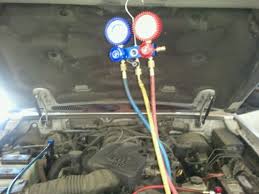 away heat). Leaks are easy to spot but not easy to fix without pulling the auto AC system apart. Most auto-supply stores carry a fluorescent dye that can be added to the system to check for leaks, and it will have instructions for use on the can. If there’s a bad enough leak, the system will have no pressure in it at all. Another part of auto AC basics; find the low-side valve for the auto AC and with a special gauge check the PSI level.
VERY IMPORTANT
•Do not use anything else to poke in the auto AC valve to see if coolant will come out, this is illegal and one of the auto AC basics. It’s called venting. Make sure the compressor is turning.
•Start the car, turn on the auto AC and look under the hood. The auto AC compressor is generally a 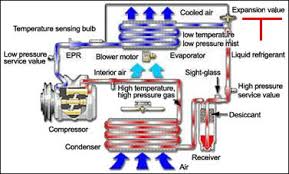 pump-like thing off to one side with large rubber and steel hoses going to it. It will not have a filler cap on it, but will often have one or two things that look like the valve stems on a bike tire, this is part of auto AC basics and will be similar on every car. The pulley on the front of the auto AC compressor exists as an outer pulley and an inner hub which turns when an electric clutch is engaged.
•If the auto AC is on and the blower is on, but the center of the pulley is not turning, then the compressor’s clutch is not engaging, you have run into one of the auto AC basics. This could be a bad fuse, a wiring problem (see Pops Auto Electric on Auto Electric Repair), a broken auto AC switch in your dash, or the system could be low on refrigerant (most systems have a low-pressure safety cutout that will disable the compressor if there isn’t enough refrigerant in the auto AC system). Look for other things that can go wrong. The other sorts of problems that the auto AC might be experiencing include: bad switches, bad fuses, broken wires, broken fan belt (preventing the pump from turning), or seal failure inside the compressor. Feel for any cooling at all. If the system cools, but not much, it could just be low pressure in the auto AC and you can top up the refrigerant. Most auto-supply stores will have a kit to refill a system, complete with instructions.
VERY IMPORTANT
•Auto AC basics; do not overfill the auto AC coolant! Adding more than the recommended amount of refrigerant will 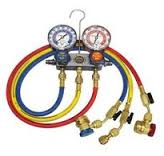 not improve performance but actually will decrease performance. In fact, the more expensive automated equipment found at nicer shops actually monitors cooling performance in real-time as it adds refrigerant. When the performance begins to decrease it removes refrigerant from the auto AC until the performance peaks again.
Tips
•Auto AC basics; if you suspect bad wiring, most compressors have a wire leading to the electric clutch. Find the connector in the middle of that wire, and unplug it. Take a length of wire and run it from the 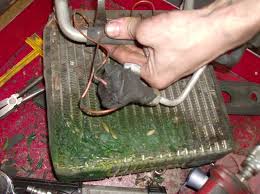 compressor’s wire to the plus (+) side of your battery. If you hear a loud CLACK, the electric clutch for the auto AC is fine and you should check the car’s wiring and fuses. If you get nothing, the electric clutch is bad and the auto AC compressor will have to be replaced. Ideally, if you can do this test while the car is running, you can see if the hub spins. Take care to keep fingers and loose clothes away from moving pulleys and belts. That would rule out an auto AC clutch that actuates properly but then slips so badly it won’t generate pressure.
•Auto AC basics 2; the auto AC system will have a light oil in it. •If your car has an auto AC, leak even though the drain pipe is clean, some water may have entered the AC system during a drive through rain.
•Another possible replacement refrigerant is HC12a which is used quite a bit more in Europe. This is another one of the auto AC basics as It performs better than R-134a or R12. It is more flammable. HC12a is illegal in many U.S. states, 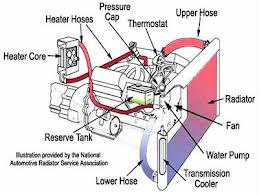 including Arkansas, Arizona, Connecticut, Florida, Idaho, Iowa, Indiana, Kansas, Louisiana, Maryland, Montana, Nebraska, North Dakota, Oklahoma, Texas, Utah, Virginia, Washington, Wisconsin, and the District of Columbia. HC12a has a lesser environmental impact than R12 or R134a, but since HC12a contains hydrocarbons, it could contribute to volatile organic compound (VOC) emissions. This substance must be ordered on the Internet as local shops do not seem to stock it. The issue is that shops will not work on a car that has other refrigerants in it. Special equipment is needed for each type of refrigerant’s recovery. Standard R12 or R134a is a safer choice for any auto AC system.
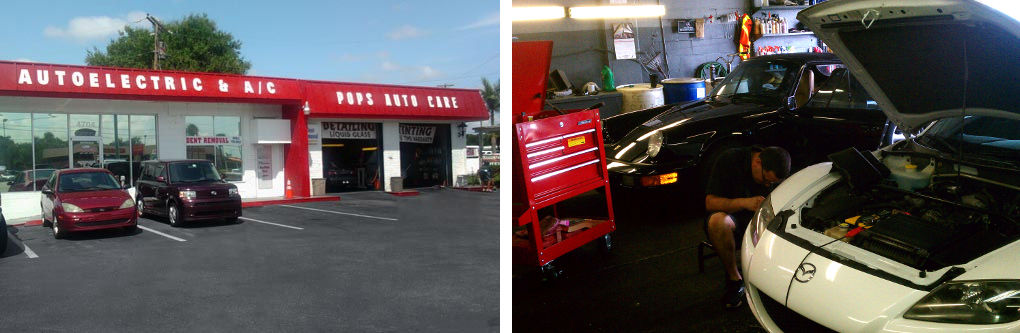
•Sometimes the problem is not always about the refrigerant, or any of the auto AC basics. There may be a problem with heat radiation from nearby engine which is very hot and decrease the AC efficiency and performance. You 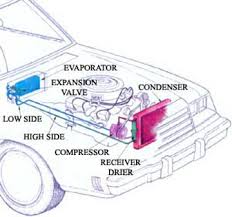 can try to wrap / isolate the cold auto AC pipe near the engine to stop engine heat radiation from affecting the pipe and increase auto ac performance overall. Seem complicated, we can help. For many years Pops Auto Electric in Orlando has been the expert dealers bring their problem auto AC systems to fix the auto AC basics and the more critical problems as well. These dealers and shops know that Pops Auto Electric will not only fix the problem with auto AC basics, but do it as efficiently and inexpensively as possible.
Pops Auto Electric located at the corner of Orange and Holden have all the latest in auto AC repair equipment, you can’t find a more competent or honest shop.

Pops Auto Electric of Orlando Florida
407-857-8579

If you feel you have the expertise to continue repairing your auto AC basics yourself; we do feel we must list the following warnings:
Warnings
•You may not find a repair facility that will simply not top off the auto AC basics system, if they suspect that you need to repair a leak first. If you repaired the leaks and failed components yourself, it is legal to recharge the auto AC basics system with 134 without a license, but not R-12. However, getting a license to handle R-12 is easy online, and runs about $20.)
•Look out for moving fan blades and fan belts!
•If you have any reason to suspect that your auto AC refrigerant has leaked out completely (the auto AC DIY pressure gauge you bought at the parts store reads 0 psi; the compressor won’t engage because it may be sensing no pressure in the system; you checked the gauge and have no PSI level), then you are 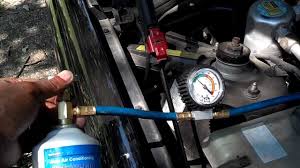 best off taking it to a professional unless you are familiar with what you are doing. As a general rule of thumb, you are probably not familiar enough if you are reading this article. The reason for this is that a completely depleted auto AC basics refrigerant system has no pressure to keep air and moisture from coming in through wherever the refrigerant leaked out. Air and moisture are possibly the two biggest enemies of an auto AC system. The ways in which they can do harm are outside the scope of this article, but suffice it to say that it is not okay to have a significant amount of either air or moisture in the auto AC lines. The receiver/dryer unit must be replaced in a case like this as you can almost guarantee that it has absorbed enough moisture to be completely useless, and before refilling the system it must be evacuated (pulling a vacuum on the system, effectively removing nearly all air and moisture from inside) with the proper equipment, which few auto AC Dyers are likely to have access or knowledge to use. Let a professional handle it, and you may get away with paying for a fixed leak and an evacuate/recharge of the auto AC system. Try to fix the auto AC yourself, and a few months down the
  road you might wind up having to pay for the same evacuate/recharge service, plus replacement of a seized compressor, as well as a new condenser, evaporator, and expansion valve/orifice tube because the compressor sent shards of metal throughout the entire auto AC basics system when the compressor died.
•HC12 and R-134A are non-flammable auto AC fluids at ambient temperatures and atmospheric pressure, but both may combust at high pressure and temperature under certain conditions (in contact with certain reactive metals), again, part of auto AC basics. Both also displace oxygen, so do not release a lot of the gas in a small, non-vented area under penalty of asphyxiation.
•Stay away from major leaks of refrigerant. As it vents the auto AC system, it will get cold enough to freeze your skin, resulting in frostbite, this is another of the auto AC basics. •Never connect auto AC refrigerant cans, oil or leak-detector cans to the “high pressure side” of the system, part of auto AC basics. This is often marked with H or HIGH, or a red connector cap. Cans can explode, and that would hurt. •Checking for refrigerant leaking from the auto AC system by poking something in the fitting and looking for venting may be illegal if it releases refrigerant into the atmosphere. (Please don’t do this with R-12 especially!) While it is not illegal to top off a leaking system, you must check your local regulations, as in some cases there is a state or local law against it, due to the possible emissions. Venting auto AC refrigerant, even R-134a, is illegal in the United States, so act accordingly, this is law regarding auto AC basics. •Be extremely cautious about converting your old R-12 auto AC system to R-134a. The R-134a conversion kits sold at Auto Parts stores and even Walmart, are called “Black Death Kits” by some auto AC repairmen. Frequently part of auto AC basics, the new R-134a refrigerant will not circulate the R-12 oil and you will burn up your compressor. The R-12 mineral oil has chlorine contaminants that will destroy the R-134a PAG or POE special oil. The only way to reliably convert auto AC from R-12 to R-134a is to remove the compressor and flush out all the old oil with the new type of oil; then replace the old Receiver-Dryer or Accumulator with a new one; then flush out all the lines, the evaporator, and the auto AC condenser with special cleaner then vacuum to a steady vacuum; and finally charge with 70-80%, (by weight) of the original R-12 weight, with R-134a; and expect poorer cooling ability. It is much easier to keep the old R-12 auto AC system running with R-12 that is readily available via eBay. You must have a license to buy and sell R-12, again auto AC basics.
◦Note that the above warning is controversial. Some repairmen claim to have converted hundreds of vehicles from R-12 to R134a without any problems or issues or failures after conversion.
Seem complicated, we can help with all the auto AC basics and beyond. For many years Pops Auto Electric in Orlando has been the expert dealers bring their problem auto AC systems to fix. These dealers and shops know that Pops Auto Electric will not only fix the problem, but do it as efficiently and inexpensively as possible. Pops Auto Electric located at the corner of Orange and Holden have all the latest in auto AC repair equipment, you can’t find a more competent or honest shop.
Pops Auto Electric of Orlando Florida
407-857-8579